
Hiring Software Developers in the Philippines: A Guide for Australian Businesses
Australian companies often look to the Philippines when they need product delivery or additional engineering capacity. The model works best when capability, communication, technical leadership, and ownership matter more than finding the lowest hourly rate.
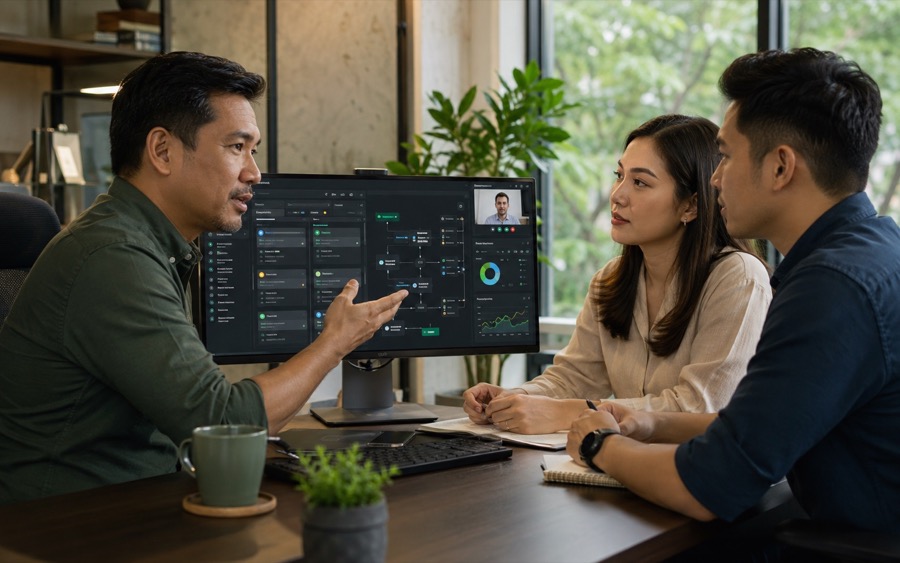
Responsible offshore delivery depends on team fit, engineering practice, and clear ownership.
Why Australian businesses consider the Philippines
The Philippines offers software professionals across web, mobile, backend, cloud, quality assurance, and product disciplines. English is widely used in professional settings, and working hours can be arranged with practical overlap across Australian time zones.
Those conditions can support collaboration, but they do not guarantee it. Individual skill, seniority, company practices, role clarity, and team integration remain decisive. Evaluate the people and delivery system rather than relying on assumptions about a country.
Choose the right engagement model
Direct hire
A direct employee can become deeply integrated with the product and organisation. The business must be ready to source, assess, onboard, manage, support, and retain that person, and should obtain appropriate advice about employment, tax, and cross-border arrangements.
Independent contractor
A contractor can suit defined specialist work or a flexible period of capacity. Clarify deliverables, availability, intellectual property, confidentiality, security access, and handover in writing. Classification and legal obligations require advice appropriate to the arrangement.
Development partner
A software development partner may provide engineering leadership, delivery management, review practices, and continuity around individual contributors. Confirm who actually performs the work, how much senior oversight is included, and who owns delivery decisions.
A dedicated developer is not automatically the best answer. A bounded project, a part-time specialist, or an Australian–Philippines blended team may fit the need better.
Evaluate engineering capability, not just a CV
- Use a technical conversation based on work similar to your actual product.
- Ask the candidate to explain trade-offs, failure modes, testing, and maintenance.
- Review a small, respectful work sample or conduct collaborative problem-solving.
- Assess the seniority required for ambiguous decisions, not only coding tasks.
- Check how the person communicates uncertainty and asks for missing context.
- Confirm experience with your source control, review, deployment, and incident practices.
A strong interviewer looks for clear reasoning and maintainable decisions. Trivia-heavy tests can miss the skills required to work responsibly in an existing system.
Set expectations for remote collaboration
Time-zone overlap
Agree on a dependable overlap window for planning, decisions, and unblocking. Do not turn overlap into an expectation of permanent availability. Document decisions so progress does not depend on meetings.
Delivery visibility
Use small milestones, an accessible backlog, working demonstrations, and clear acceptance criteria. Progress should be visible in working software and reviewed changes, not inferred from activity reports.
Communication
Define which channel handles urgent issues, where product decisions live, and when engineers should escalate risk. Encourage questions early; silence should not be rewarded when requirements are unclear.
Engineering controls that support quality
Every contributor should use organisation-controlled source repositories, reviewed changes, repeatable environments, issue tracking, and a defined deployment process. Automated tests should protect important behaviour, while code review should examine design, security, readability, and product impact—not merely formatting.
Senior engineers matter most where architecture is uncertain, integrations are risky, or junior contributors need direction. Ask who approves major technical decisions and how quality is maintained when delivery pressure increases.
Security, IP, and access
Provide only the access required for the role, use individual accounts and multi-factor authentication, keep secrets out of source code, and remove access promptly at the end of an engagement. Decide what data may be used in development and provide safe test data where possible.
Contracts should clearly address confidentiality, intellectual property, third-party code, source ownership, and handover. Requirements differ by business and jurisdiction, so obtain qualified legal advice rather than relying on a generic outsourcing template.
Onboarding, knowledge transfer, and continuity
- Explain the product, users, business model, and current priorities.
- Provide architecture, setup, coding, testing, and release guidance.
- Start with a contained change that exercises the real workflow.
- Pair with an experienced team member on the first decisions.
- Keep decisions, operational procedures, and known risks documented.
- Plan for leave, turnover, and handover before they become urgent.
Documentation should be maintained as work changes. A repository no one else can run or a product understood by one offshore developer is not durable capacity.
Risks of hiring on hourly price alone
A low rate does not reveal the cost of rework, weak architecture, slow decisions, security gaps, missed product context, or management overhead. Compare expected outcomes, senior involvement, communication, continuity, and total ownership cost.
The same principle applies when estimating an entire build. See our guide to custom software development costs in Australia for the broader scope and maintenance factors.
When offshore development may not fit
Offshore delivery may be unsuitable when regulation or contracts impose location restrictions, stakeholders cannot provide timely product decisions, the work requires constant physical presence, or the organisation lacks anyone able to own product priorities. It may also be premature when the business problem is still too unclear to define useful work.
For suitable projects, BuildMint's offshore product engineering service emphasises senior-led engineering, communication, product understanding, and clear milestones from the Philippines.
Need additional software engineering capacity?
Tell us what you are building, the skills you need, and how you want the developer or team to work with your business.